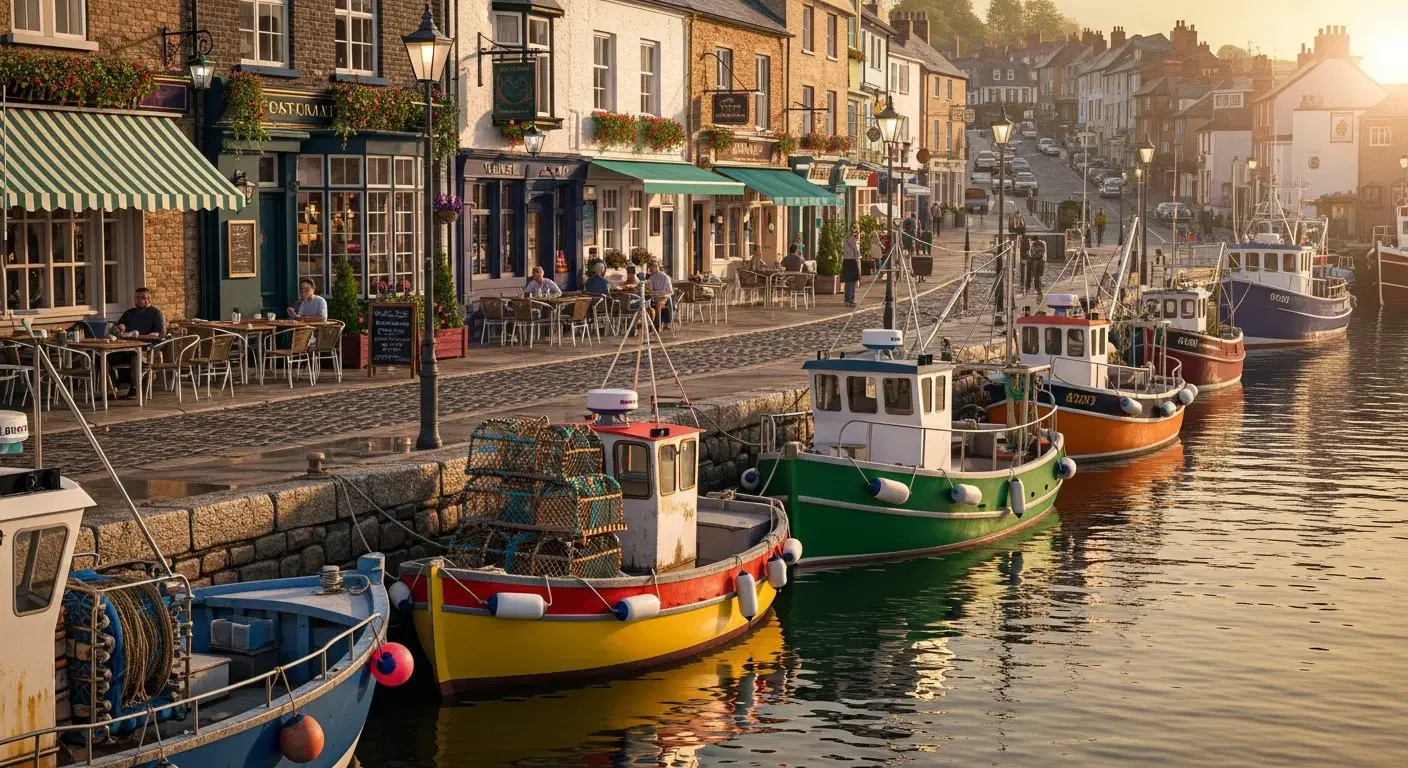
Tynemouth and the Port of Tyne
The North Shields Fish Quay, the Tyne Piers, the lighthouses, the fishing industry, and the modern port -- how the mouth of the Tyne has served as a working harbour for over 800 years.
The mouth of the River Tyne has been a working harbour for over eight centuries. From the medieval shielings where fishermen dried their catch to the modern port that handles cars, cargo, and cruise ships, the river entrance at Tynemouth and North Shields has shaped the life and livelihood of everyone who has lived here. This is the story of the Port of Tyne -- its fish quay, its piers, its lighthouses, and the industries that rose and fell at the river's edge.
The Fish Quay: 800 Years of Fishing
Medieval Origins
The North Shields Fish Quay traces its origins to 1225, when a settlement of shielings -- seasonal huts used by fishermen -- grew up around the Pow Burn on the north bank of the Tyne. The settlement existed to serve the nearby Tynemouth Castle and Priory, providing fish for the monks and the garrison.
For centuries, the development of North Shields was deliberately restricted by the neighbouring port of Newcastle upon Tyne. Newcastle's powerful trade guilds resented any commercial activity outside the city. Coal mined in North Shields within 300 feet of the river had to be transported overland eight miles to Newcastle to be loaded onto boats. Fishing was tolerated; trade was not.
It was not until the guilds' monopoly weakened in the seventeenth and eighteenth centuries that North Shields was able to develop as a port in its own right.
Best for: The Fish Quay dates to 1225. For centuries, Newcastle's trade guilds restricted North Shields' development, allowing fishing but blocking commercial trade.
The Herring Boom
By the nineteenth century, North Shields had become one of the biggest herring producers in Britain. The Fish Quay was the centre of the industry -- a chaotic, bustling waterfront where trawlers landed their catch, women gutted and packed the fish, and merchants haggled over prices. The herring were cured, salted, and exported across Europe.
The industry supported an entire community: fishermen, fish wives, net makers, boat builders, coopers (who made the barrels for salted fish), and the merchants who sold the catch. The streets around the Fish Quay were dense with lodging houses, pubs, chandlers, and rope walks.
Decline and Reinvention
The fishing industry declined in the second half of the twentieth century. Overfishing, changing markets, and competition from foreign fleets reduced the catch. By the 1980s, the Fish Quay was struggling. Many of the warehouses and lofts that had stored fish and nets stood empty.
But the quay did not die. Over the past two decades, it has been reinvented as one of the North East's most exciting dining destinations. The fishing boats still land their catch here daily -- the Low Lights fish market operates every weekday morning -- but the old buildings now house restaurants, bistros, and bars. The Fish Quay dining guide covers the best places to eat.
The Lighthouses
Navigating the mouth of the Tyne was dangerous. Sandbars, tidal currents, and the rocks known as the Black Middens wrecked ships with brutal regularity. Lighthouses were essential.
The High and Low Lights
North Shields operated a system of leading lights -- two lighthouses, one higher than the other, which sailors would line up to find the safe channel into the river. When the two lights appeared one above the other, the ship was on the correct bearing.
The older pair of lights dates from 1727 and remained operational until 1810. A newer pair then took over, remaining in use until 1999 -- nearly two hundred years of guiding vessels safely home.
The Old Low Light building on the Fish Quay has been converted into a heritage centre, which opened in 2015. It tells the story of the lighthouses and the maritime community they served.
Best for: The High and Low Lights of North Shields guided ships into the Tyne from 1727. The newer pair remained in use until 1999.
Tynemouth Lighthouse
At the end of the North Pier stands Tynemouth Lighthouse, built as part of the pier construction in the late nineteenth century. It marks the northern entrance to the Tyne and is one of the most photographed landmarks on the North East coast. The lighthouse is not open to the public, but it can be seen clearly from the pier walkway and from the headland at Tynemouth Priory.
The Tyne Piers
Before the piers were built, many ships foundered on the Black Middens -- a stretch of rocks that lies to the east of the Fish Quay and can still be seen at low tide. The wrecks were so frequent and so deadly that the construction of protective piers became a matter of national urgency.
Construction
In 1850, the Tyne Improvement Commission was established to maintain the river and improve navigation. The first foundations of Tynemouth Pier (the North Pier) were laid in 1854, using 3,000 tonnes of stone in what was one of the most difficult construction projects of its kind. Work on the South Pier, on the opposite bank at South Shields, began in 1856.
The North Pier extends 899 metres from the headland below Tynemouth Priory. The South Pier is even longer -- 1,570 metres. Together, they shelter the river mouth from the full force of the North Sea, creating a protected entrance for vessels of all sizes.
Storm and Rebuilding
The North Pier was completed in 1895. Just two years later, a devastating storm almost completely destroyed it. The rebuilding was entrusted to John Wolfe-Barry -- the engineer most celebrated for his design and construction of Tower Bridge in London. The rebuilt pier was completed in 1909 and has withstood the North Sea ever since.
Best for: The Tyne piers were built from 1854 to shelter the river mouth. The North Pier was destroyed by a storm in 1897 and rebuilt by the engineer who designed Tower Bridge.
The Tynemouth Volunteer Life Brigade
The dangers of the river mouth led to one of Tynemouth's most important institutions. On 24 November 1864, a fierce south-easterly gale drove two vessels onto the Black Middens rocks. Thirty-two people died. The tragedy led directly to the founding of the Tynemouth Volunteer Life Brigade (TVLB) -- the world's first volunteer coastal rescue organisation.
The TVLB's Watch House still stands above the river mouth, overlooking the rocks where the 1864 disaster occurred. It is now a museum containing an extraordinary collection of rescue equipment, shipwreck artefacts, and photographs spanning over 160 years.
The Modern Port of Tyne
The Port of Tyne is one of the UK's major deep-sea ports. It handles a diverse range of traffic from facilities on both banks of the river:
- Car terminals -- the port handles the import and export of thousands of vehicles each year
- Cruise terminal -- at Northumbrian Quay on the north side, serving the growing cruise industry
- Ferry terminal -- at North Shields, operated by DFDS for passenger and freight services to Amsterdam
- Cargo and bulk handling -- at the Riverside Quay, handling conventional and bulk cargoes
- Offshore energy -- increasingly, the port supports the offshore wind and renewable energy sectors
The Port of Tyne is also the custodian of the historic piers, carrying out regular inspections and maintenance to preserve the Victorian engineering that still protects the river entrance.
Walking the Heritage
The maritime heritage of Tynemouth and North Shields is accessible on foot. The heritage walking trail covers the Priory headland, the Spanish Battery, the Watch House, and the pier. The coastal walk connects Tynemouth to St Mary's Lighthouse via the cliffs and beaches of Cullercoats and Whitley Bay.
At the Fish Quay itself, the Old Low Light heritage centre, the fish market, and the restaurants and pubs that line the waterfront are all within walking distance. The quay is a 25-minute walk from Tynemouth via the coastal path, or one Metro stop to North Shields.
More on Tynemouth's heritage: read our guides to the Volunteer Life Brigade, Tynemouth Priory and Castle, the Spanish Battery, and Vikings, Monks, and Kings. Browse the local directory or check what's on this week.
Know something we've missed? Get in touch and we'll add it.
Never miss what’s on
Join the weekly Tynemouth.live digest — the best events, news and local tips, straight to your inbox. Free, one email a week.
What's On
Tynemouth Station Market
9:00am - 3:30pm · Tynemouth Metro Station, Station Terrace, Tynemouth, NE30 4RE
Halloween Maze and Pumpkin Trail
9:30 AM · Tynemouth Park, Grand Parade, Tynemouth, NE30 4JL
Make a Mythical Monster Shield at Segedunum Roman Fort
11:00 AM - 3:00 PM · Segedunum Roman Fort, Buddle Street, Wallsend, NE28 6HR