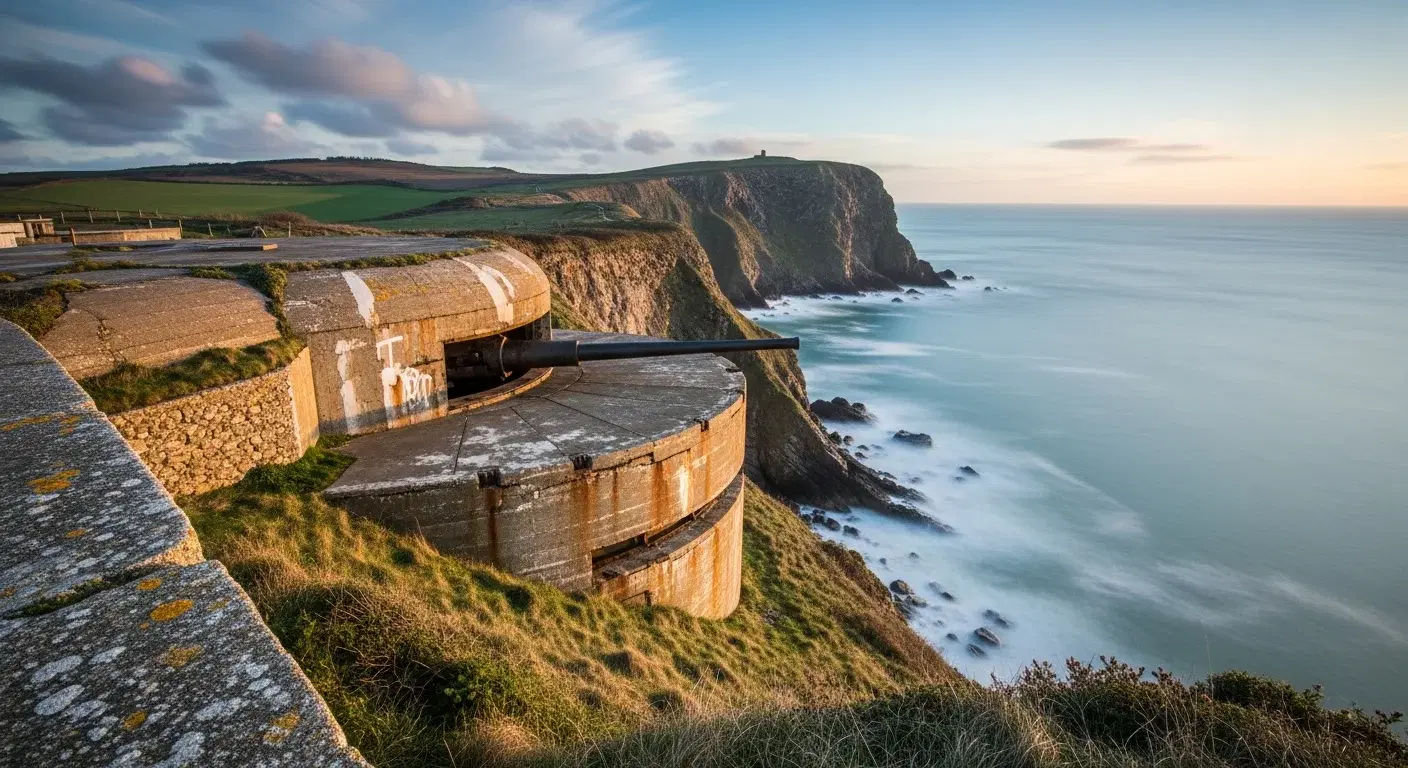
The Spanish Battery & WWII Defences: Tynemouth's Forgotten Fortifications
The story of the Spanish Battery, from Henry VIII's mercenary-manned fort in 1545 to the Mk VII naval guns that guarded the Tyne through two world wars.
Most visitors to Tynemouth know the headland for the Priory and Castle. Far fewer realise that a second set of fortifications, older in origin and with a military history stretching from the Tudors to the Second World War, lies just a short walk away. The Spanish Battery is today used mainly as a car park, but beneath the tarmac and around its edges, nearly five centuries of coastal defence survive.
Henry VIII and the Spanish Mercenaries
In 1545, Henry VIII ordered the construction of a gun battery on the promontory overlooking the mouth of the River Tyne. The king needed to defend his fleet as it assembled in the Tyne before sailing north to invade Scotland. The position was ideal, a rocky headland with commanding views of the river entrance and the open sea beyond.
The guns were manned by Spanish mercenaries, professional soldiers hired from Spain, which was then an ally of England. It is from these Spanish gunners that the battery takes its name, a label that has stuck for nearly 500 years despite the site's many subsequent transformations.
Best for: The name "Spanish Battery" has survived since the 1540s, one of Tynemouth's oldest place names still in everyday use.
Civil War and Beyond
The fortifications were repaired and the defensive walls raised in 1643, during the English Civil War, when control of the Tyne was strategically vital. The layout of the batteries changed over the following centuries, but by the mid-19th century the original structures were largely in ruins.
The site might have been forgotten entirely had it not been for the growing threat of naval warfare in the late Victorian period.
Modernisation: The 1902 Batteries
In 1902, the Spanish Battery was comprehensively modernised as part of a wider programme of coastal defence. The old earthworks were replaced with concrete emplacements designed to house modern artillery. The battery was equipped with:
- A single 6-inch Mk VII breech-loading naval gun
- Two 6-pounder Quick Firing guns
These were serious weapons, the 6-inch gun could hurl a 100-pound shell over 10 miles. Concrete emplacements along the eastern edge of the headland protected the guns, with command and control buildings set behind them and underground magazines providing ammunition storage.
Together with a matching pair of 6-inch guns at Tynemouth Castle, the Spanish Battery formed part of the fixed defences guarding the entrance to the Tyne, one of the most important commercial and military waterways on the east coast of England.
The First World War
When war broke out in 1914, the Tyne's shipyards, armaments factories, and coal-exporting wharves made the river a prime target. The Spanish Battery was fully manned throughout the conflict, its guns trained on the sea approaches to deter any attack on the river entrance.
The deterrent worked. Although German U-boats and surface raiders operated in the North Sea, the Tyne was never directly attacked from the sea during the First World War.
The Second World War
The battery was manned again from 1939, this time as part of the Tyne and Tees coastal defences. The two 6-inch guns at the Spanish Battery and two at Tynemouth Castle were among the last coastal guns retained in the area, all others had been removed.
The guns were operated by the Coastal Regiment, Royal Artillery, and formed part of a layered defensive system that included searchlights, observation posts, anti-submarine nets, and minefields across the river mouth. Once again, the deterrent held, no enemy vessel attempted a surface attack on the Tyne, though the area suffered heavily from aerial bombing.
The Spanish Battery was stood down from active service in 1943, as the threat of surface attack receded. The guns were eventually removed and the site cleared in 1954.
What Survives Today
The Spanish Battery is now used as a car park, a convenient stopping point for visitors heading to the Priory, the Watch House Museum, or the coast path. But look carefully and you will find more than you expect:
- Concrete gun emplacements from the 1902 modernisation are still visible along the eastern edge
- Underground magazines and access passages survive beneath the surface
- Partial stone walls and a defensive ditch from the original Tudor fort can still be traced
- The route of the passage leading down to the river is discernible on the northern side
None of this is formally interpreted or signposted, which only adds to the appeal for anyone who enjoys discovering hidden history in plain sight.
Best for: Next time you park at the Spanish Battery, take five minutes to walk the eastern edge. The concrete gun emplacements are remarkably well preserved.
Visiting
The Spanish Battery car park is on Pier Road, a short walk from Tynemouth village centre. It is pay-and-display, with spaces for up to three hours. The Watch House Museum of the Tynemouth Volunteer Life Brigade is immediately adjacent, and the Collingwood Monument stands nearby.
For the full story of coastal defence at Tynemouth, combine a visit here with the Priory and Castle, where the WWII gun battery and "Life in the Stronghold" exhibition cover the headland's military history in much greater depth.
Interested in Tynemouth's history? See our guides to the Priory and Castle and the Tynemouth Volunteer Life Brigade. Get in touch.
Never miss what’s on
Join the weekly Tynemouth.live digest — the best events, news and local tips, straight to your inbox. Free, one email a week.