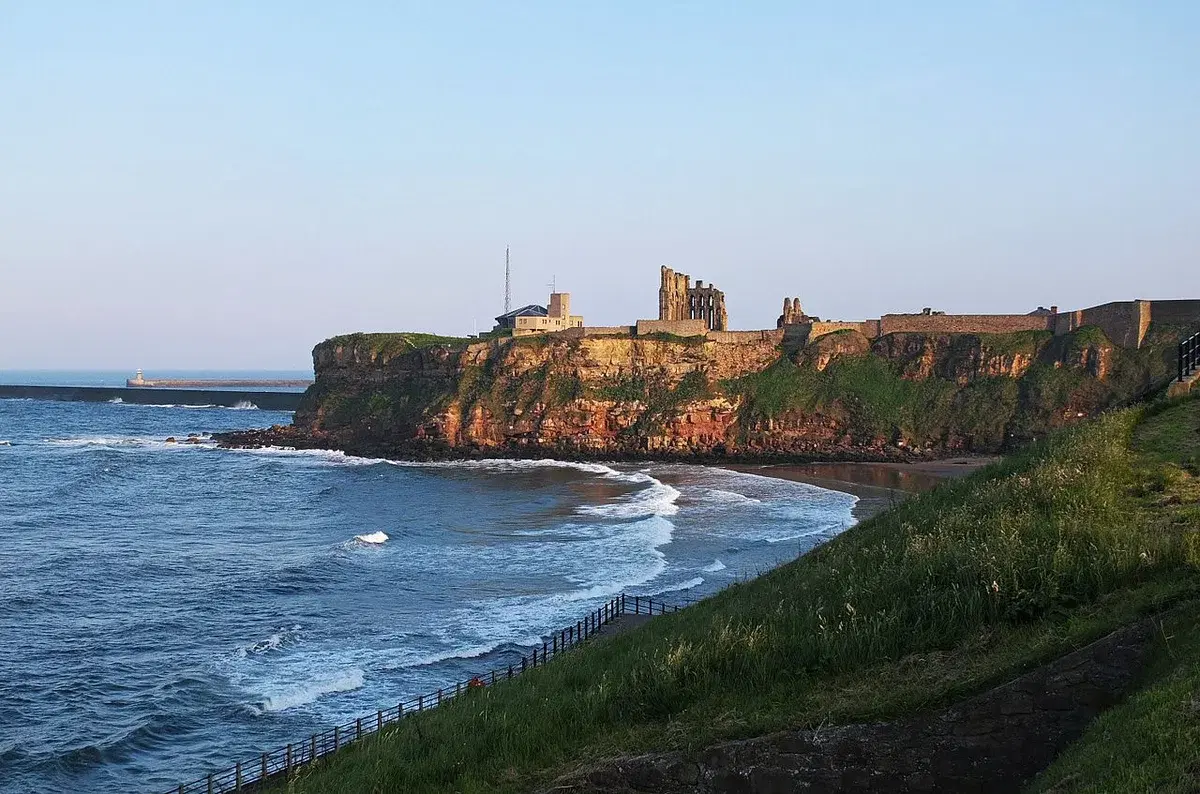
Tynemouth: Vikings, Monks, and Kings
An Anglo-Saxon monastery, five Viking raids, a Benedictine priory, a royal fortress, and a Civil War siege -- the full story of the headland at the mouth of the Tyne.
The headland at the mouth of the River Tyne has been occupied for over two thousand years. It has been a monastery, a fortress, a prison, a garrison, and a ruin. Kings have been buried here. Vikings have sacked it. Monks have prayed here for centuries. Soldiers have defended it through civil wars and world wars.
This is the story of Tynemouth Priory and Castle -- not as a visitor attraction, but as a narrative. Thirteen hundred years of history, told in sequence.
The First Monastery
The earliest monastery at Tynemouth was probably founded in the first half of the eighth century. The Venerable Bede, writing from nearby Jarrow, recorded that a monk named Herebald was abbot of Tynemouth and died in 745 AD. This places the monastery firmly in the golden age of Northumbrian Christianity -- the same era that produced Lindisfarne, Jarrow, and Wearmouth.
By the late eighth century, the monastery was important enough to be chosen as the burial place of King Osred II of Northumbria, who died in 792. This was a mark of high status: other great monasteries, including Jarrow and Lindisfarne, were passed over in favour of Tynemouth. Fragments of Anglo-Saxon crosses have been found on the headland, along with the trace remains of five rectangular wooden buildings from this period.
A later tradition claimed that the monastery was founded even earlier -- in the mid-seventh century -- as the burial place of King Oswine of Deira, who was murdered by his rival Oswiu in 651 AD. According to this account, Oswiu founded the monastery in penance for the killing, and Oswine's tomb became a place of pilgrimage. However, Bede made no mention of this story, and no other Anglo-Saxon source confirms it. The cult of St Oswin appears to have developed later, in the eleventh century, when the monastery was refounded.
Best for: King Osred II of Northumbria was buried at Tynemouth in 792 -- a mark of the monastery's importance in the Anglo-Saxon world.
The Vikings Come
The ninth century brought destruction. The monastery at Tynemouth became a target for Viking raids -- not once, but repeatedly. The documented attacks came in 800, 832, 865, and 870, each one bringing violence and plunder to the headland.
The final blow fell in 875, when a Viking raid destroyed the monastery entirely. The raiders themselves appear to have occupied the headland for a short time before moving on. After that, the site lay in ruins for two centuries.
This pattern of destruction was not unique to Tynemouth. Lindisfarne was sacked in 793, Jarrow in 794. The great monasteries of Northumbria, which had produced some of the finest scholarship and art in early medieval Europe, were systematically looted and burned by Scandinavian raiders over the course of the ninth century. Tynemouth's monastery -- exposed on its headland, visible from the sea, and wealthy enough to be worth attacking -- was among the last to fall.
Best for: Viking raiders attacked Tynemouth five times between 800 and 875. The final raid destroyed the monastery. The site lay in ruins for two hundred years.
Refoundation
The monastery was refounded in 1083 by a Benedictine monk named Turchil, from the community at Monkwearmouth-Jarrow (itself a daughter house of Durham). Turchil's revival was modest, but it set the stage for what followed.
In 1090, Robert de Mowbray, Earl of Northumbria, granted his lands in and around Tynemouth to the great Abbey of St Albans in Hertfordshire. This was a significant act: it placed a Northumbrian monastery under the control of one of the wealthiest and most powerful abbeys in England, far to the south. From this point on, Tynemouth Priory was a "cell" of St Albans -- governed by a prior appointed from the mother house, and sending its revenues south.
Construction of a new church began shortly after the grant. The church was dedicated to St Oswin (the seventh-century king whose cult was now actively promoted) and to the Virgin Mary. The shrine of St Oswin became a major focus of pilgrimage, and the priory prospered.
The Warrior Earl
Robert de Mowbray's relationship with Tynemouth did not end with his grant to St Albans. In 1095, he rose in revolt against King William Rufus, choosing Tynemouth as his stronghold. Mowbray fortified the headland, converting the monastic enclosure into a defensive position.
William Rufus besieged the castle. After six days, the royal forces broke through the defences. Mowbray escaped south to Bamburgh but was eventually captured at Tynemouth itself, wounded and taken prisoner. He spent the rest of his life in confinement -- over thirty years -- dying in prison around 1125.
The siege of 1095 was the first of many times the headland would be fought over. The combination of monastery and fortress -- spiritual house and military stronghold -- defined Tynemouth for the next five centuries.
Best for: In 1095, the Earl of Northumbria chose Tynemouth as his stronghold for a revolt against the king. After a six-day siege, the royal forces broke through.
The Medieval Priory
Over the following centuries, the Benedictine monks built the substantial church and priory buildings whose ruins stand on the headland today. The priory church featured an impressive presbytery with elegant lancet windows at the east end -- still standing, still framing views of the North Sea.
In 1296, King Edward I granted the prior permission to build stone walls around the entire site. The great gatehouse, built around 1390, was designed to be the strongest part of the fortification -- a massive stone structure controlling the only landward approach to the headland. It remains one of the most impressive medieval gatehouses in the North East.
The priory was prosperous but not always peaceful. Its position on the coast, and its dual role as monastery and fortress, meant it was repeatedly involved in the military conflicts of the medieval period. Scottish raids, border warfare, and the demands of English kings all disrupted the monks' lives.
A smaller fifteenth-century chapel -- the Percy Chantry, dedicated to the Blessed Virgin Mary -- survives in remarkably good condition. Its carved stone vaulting is one of the finest examples of late medieval craftsmanship on the site.
Dissolution
In 1536, Henry VIII brought charges of misconduct against the prior and seven of the fifteen monks. It was a familiar prelude to dissolution. On 12 January 1539, the deed was signed that surrendered Tynemouth Priory to the Crown, ending nearly five centuries of Benedictine monastic life on the headland.
The shrine of St Oswin was destroyed. The monastic buildings were stripped of their valuables. But the site was too strategically important to be abandoned.
Henry's commissioners immediately turned the priory into a defensive post to guard the mouth of the River Tyne. In the 1540s, as Henry feared war with France, major fortification works were undertaken. The military engineer Sir Richard Lee and an Italian expert, Gian Tommaso Scala, prepared plans for new defences -- a fortified line running west of the castle walls to a low hill where guns could command the river mouth.
This hill became the Spanish Battery, allegedly named after Spanish mercenaries employed by Henry. The priory had become a castle in earnest.
Best for: The priory was dissolved on 12 January 1539. Henry VIII's engineers immediately converted it into a coastal fortress, building the Spanish Battery to command the mouth of the Tyne.
The English Civil War
When the English Civil War broke out in 1642, Royalist forces fortified Tynemouth and enhanced the Spanish Battery. The castle became a significant stronghold in the Parliamentarian-Royalist struggle for control of the North East.
The Battle of Marston Moor in 1644 weakened the Royalist cause in the North, and Tynemouth eventually surrendered to Parliament. During the Second Civil War (1648), Royalist forces briefly reoccupied the castle, but Sir Arthur Hesilrige, the Parliamentary military commander, retook it and secured control.
The castle remained a military garrison through the Commonwealth period and beyond. By this time, the priory buildings were already falling into picturesque ruin -- the roofless church, the crumbling walls, the empty lancet windows open to the wind and the sea.
Garrison and Ruin
The military use of the headland continued long after the Civil War. Barracks were built within the walls. Gun batteries were maintained and modernised. During both World Wars, the site served as a coastal defence installation, with gun emplacements and observation posts overlooking the approaches to the Tyne.
But even as the military occupied the headland, the priory ruins became a magnet for Romantic artists and antiquarians. By the eighteenth and nineteenth centuries, the ruined church -- its east end still standing, its windows framing the North Sea -- was considered one of the most picturesque scenes in the North of England. J. M. W. Turner painted it. Thomas Girtin sketched it. The combination of medieval ruin, dramatic cliff, and open sea was irresistible.
The ruins were placed in the care of English Heritage (then the Ministry of Works) in the twentieth century, and the site has been managed as a heritage attraction ever since.
The Headland Today
Tynemouth Priory and Castle is one of the largest fortified areas in England. The ruins of the priory church, the medieval gatehouse, the Percy Chantry, the gun batteries, and the coastal fortifications together tell a story that spans from the Anglo-Saxon period to the Second World War.
The site is managed by English Heritage and is open daily. Admission charges apply, and English Heritage members enter free.
Standing at the east end of the ruined church, looking out through the lancet windows to the sea, you are looking at a view that monks saw in the thirteenth century, that Vikings saw in the ninth, and that Anglo-Saxon Christians saw in the eighth. The headland has been occupied continuously for over a thousand years, and fought over for nearly as long. It is, by any measure, one of the most historically significant sites in the North East.
Best for: For practical visitor information including opening hours and admission prices, see our complete visitor guide to Tynemouth Priory and Castle. For more Tynemouth heritage, explore the Spanish Battery and the Tynemouth Volunteer Life Brigade.
Local businesses mentioned
Never miss what’s on
Join the weekly Tynemouth.live digest — the best events, news and local tips, straight to your inbox. Free, one email a week.
What's On
Tynemouth Station Market
9:00am - 3:30pm · Tynemouth Metro Station, Station Terrace, Tynemouth, NE30 4RE
Halloween Maze and Pumpkin Trail
9:30 AM · Tynemouth Park, Grand Parade, Tynemouth, NE30 4JL
Make a Mythical Monster Shield at Segedunum Roman Fort
11:00 AM - 3:00 PM · Segedunum Roman Fort, Buddle Street, Wallsend, NE28 6HR