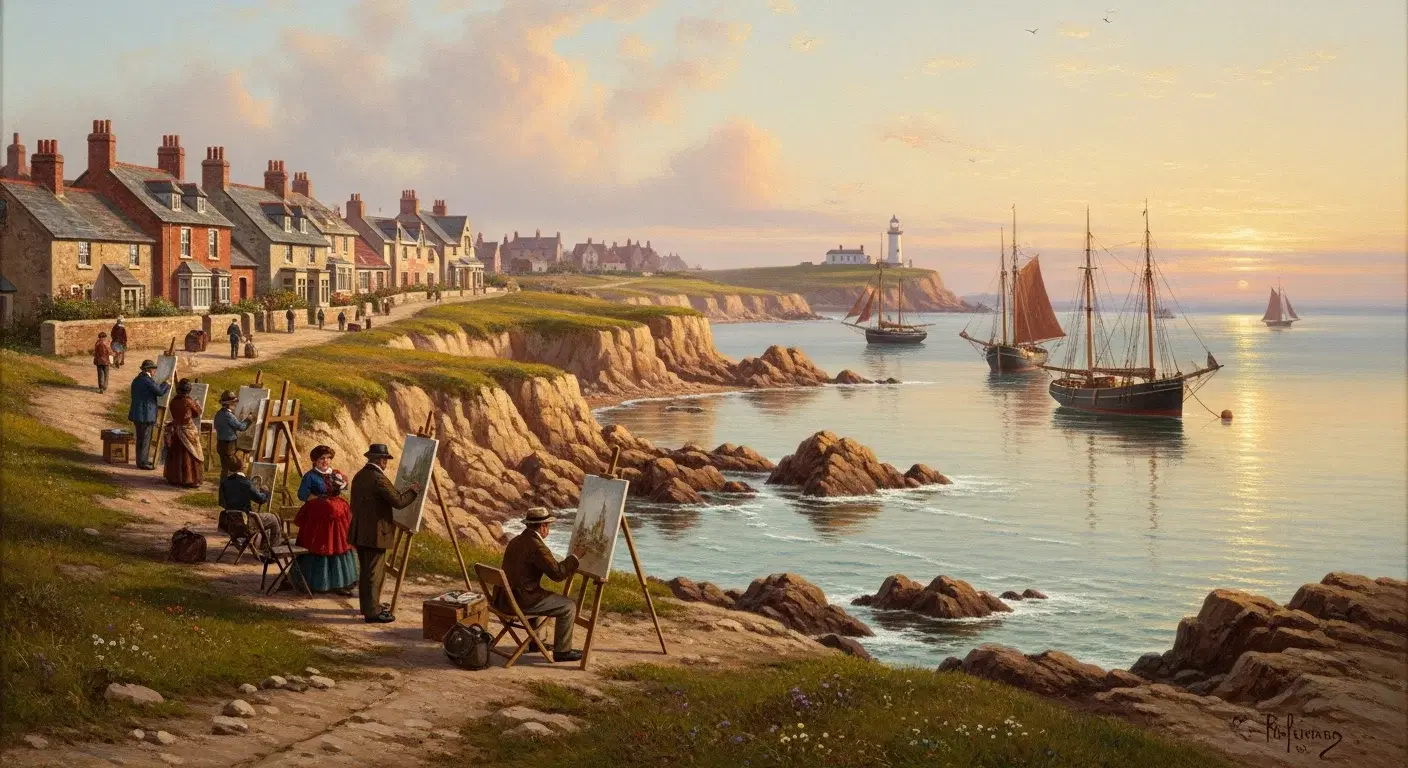
Cullercoats: The Artists' Colony on Your Doorstep
How a small North Tyneside fishing village became one of England's most important artists' colonies, and how Winslow Homer's 18 months in Cullercoats transformed American art.
Just around the headland from Tynemouth, the small bay of Cullercoats looks today much as it did in the 1880s, a crescent of sand backed by a sturdy stone harbour, a lifeboat station, and rows of fishermen's cottages climbing the bank. It is a quiet, handsome place. But between roughly 1870 and 1920, this unassuming fishing village was one of the most celebrated artists' colonies in England, and it played a pivotal role in the career of one of America's greatest painters.
The Origins of the Colony
Artists began to discover Cullercoats as early as the 1820s, when Newcastle painters including John Wilson Carmichael were drawn to the dramatic coastline, the changing light over the North Sea, and the character of the local fishing community. But it was from the 1870s onwards that Cullercoats developed a genuine reputation as an artists' colony, a place where painters could find studio space, willing models, painting supplies, and the company of fellow artists.
The appeal was obvious. The bay itself was beautiful, but it was the people who made Cullercoats irresistible to artists. The fishermen and, especially, the fishwives, strong, weather-beaten women who hauled nets, cleaned fish, baited lines, and waited on the shore for the boats to return. Were subjects of extraordinary visual power. Their lives were hard, dignified, and deeply photogenic.
Best for: The Cullercoats fishwives became some of the most painted working women in Victorian England, admired for their strength and resilience.
The Key Artists
The most prominent professional artists associated with the Cullercoats colony during its peak years of 1870 to 1920 included:
- Henry Hetherington Emmerson, one of the earliest and most prolific painters of Cullercoats life
- Robert Jobling, found national fame capturing the fishing community; his painting When the Boats Come In (Morning on the Beach) (1887) is now part of North Tyneside's Borough Art Collection
- John Charlton, a Newcastle-born painter known for his equestrian and military subjects, who also painted Cullercoats scenes
- John Falconer Slater, whose atmospheric seascapes and harbour scenes captured the mood of the bay
- Arthur H. Marsh and Isa Thompson, among several other artists who lived and worked in the village
- Ralph Hedley, a regular visitor rather than permanent resident, best known for his paintings of North East working life
Together, these artists produced a remarkable body of work that documented a way of life that was already beginning to change as the fishing industry declined.
Winslow Homer: An American in Cullercoats
The most famous artist to work in Cullercoats was not English at all. In the spring of 1881, the American painter Winslow Homer arrived in the village. He was already well known in the United States, a former Civil War illustrator who had established a reputation as a painter of rural American life. But something was missing from his work, and he knew it.
Homer stayed in Cullercoats for approximately 18 months, from late March 1881 to early November 1882. He lodged in the village, set up a studio, and immersed himself completely in the life of the fishing community.
What captivated Homer was the same thing that had drawn the English painters: the fishwives. He depicted them again and again, hauling baskets of fish, mending nets, standing at the water's edge scanning the horizon for returning boats. His Cullercoats women are monumental figures, painted with a seriousness and a grandeur that elevated them far beyond genre painting.
The effect on Homer's art was transformative. Before Cullercoats, he was a talented painter of American pastoral scenes. After Cullercoats, he was one of the greatest watercolourists of the 19th century, and arguably the greatest American painter of the sea. The shift in his style, subject matter, and ambition can be traced directly to those 18 months on the North Tyneside coast.
Best for: Winslow Homer's Cullercoats watercolours are now held in major collections worldwide, including the Metropolitan Museum of Art in New York and the National Gallery of Art in Washington, D.C.
The Cullercoats Art Walk
North Tyneside Council has created a Cullercoats Art Walk, a heritage trail that guides visitors around the village, linking key locations to the paintings that were made there. Information panels along the route reproduce the original artworks alongside historical context, showing how the bay, the harbour, the lifeboat station, and the streets looked through the eyes of the colony's painters.
The trail is free, self-guided, and takes roughly 45 minutes to an hour at a leisurely pace. It forms part of a wider series of North Tyneside heritage walks that extend along the coast from the Collingwood Monument to St Mary's Lighthouse.
You can pick up a trail leaflet from local information points or download it from the North Tyneside Council website.
Cullercoats Today
The fishing industry that sustained the colony's subjects is long gone, but Cullercoats retains much of its original character. The harbour walls and Watch House still stand. The lifeboat station, now operated by the RNLI, occupies a prominent position at the north end of the bay. The tight streets of fishermen's cottages survive largely intact, and the bay itself remains one of the most beautiful on the North Tyneside coast.
It is an easy walk from Tynemouth, the coastal path takes you around the headland past the outdoor pool (now known as Tynemouth Outdoor Pool) and along the clifftop to Cullercoats Bay. Combined with the art walk, it makes for a rewarding half-day outing that connects Tynemouth's natural beauty with a genuinely significant chapter in art history.
The Cullercoats Art Walk is free and open year-round. For more information on coastal walks, see our guide to the best walks from Tynemouth. Get in touch.
Never miss what’s on
Join the weekly Tynemouth.live digest — the best events, news and local tips, straight to your inbox. Free, one email a week.