Churches in Tynemouth
From a Gothic Revival gem on Front Street to a Grade I listed masterpiece in Cullercoats, here is your guide to churches and places of worship in Tynemouth and the surrounding coast.
Tynemouth's religious history stretches back over 1,400 years. The headland where Tynemouth Priory now stands was home to an Anglo-Saxon monastery as early as the 7th century, and the Benedictine priory that succeeded it was one of the most important monastic houses in medieval England. That priory is long ruined, but the tradition of Christian worship it established has continued without interruption. Today the area is served by a variety of churches spanning Anglican, Catholic, United Reformed, and Baptist traditions. Here is our guide to the main churches in and around Tynemouth.
Church of the Holy Saviour
Church of the Holy Saviour on The Broadway, Tynemouth, NE30 2LD, is the Church of England parish church for Tynemouth. It was built between 1839 and 1841 by the architects John and Benjamin Green, commissioned by the Duke of Northumberland. The style is 15th-century Gothic, with a cruciform plan, transepts, and a tower at the west end surmounted by a spire rising to 95 feet. The church is a Grade II listed building.
Holy Saviour's is a large, active parish church that describes itself as seeking to follow Christ faithfully. The building is open as a quiet space each day, usually from 9am until 4pm, and you are welcome to step in to find some tranquillity or light a candle. Regular services, baptisms, weddings, and funerals all take place here, and the church hall is available for community hire.
Best for: Tynemouth's Anglican parish church since 1841, Grade II listed, open daily as a quiet space.
Our Lady and St Oswin's Church
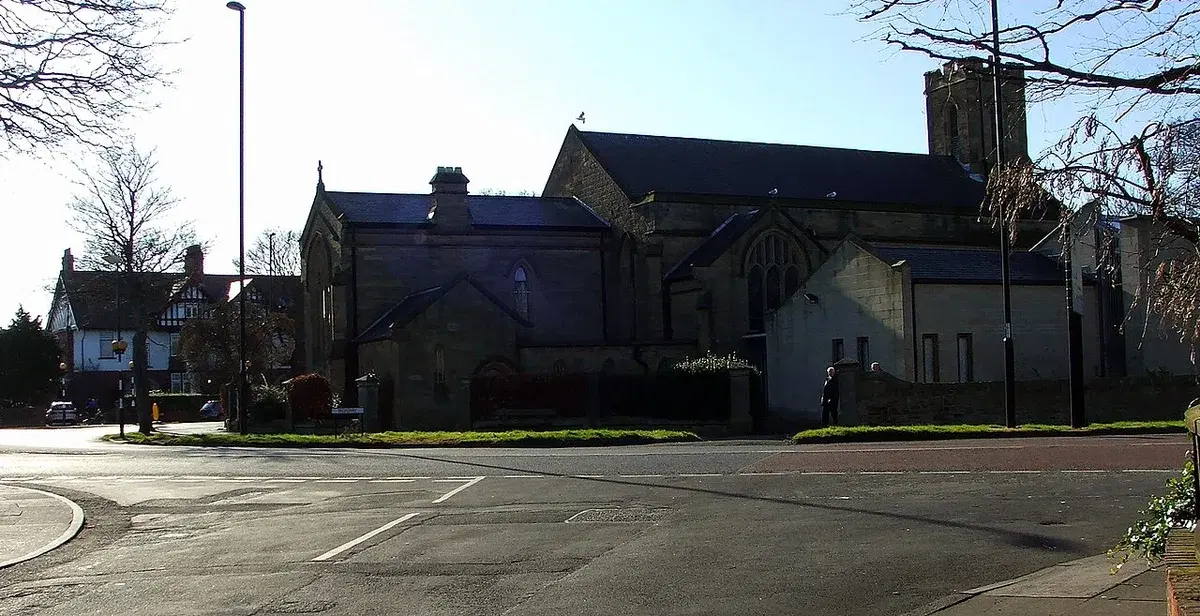
Our Lady and St Oswin's on Front Street, Tynemouth, NE30 4DZ, is the Catholic parish church for Tynemouth. It was designed by the architects Dunn and Hansom in the Gothic Revival style, with the foundation stone laid on 8 September 1889 and the church opened by Bishop Thomas Wilkinson on 1 June 1890.
The church's name honours both the Blessed Virgin Mary and St Oswin, the 7th-century King of Deira who was martyred and later venerated at Tynemouth Priory. A Catholic mission was first established in Tynemouth in 1869, with a temporary chapel opening on Front Street in 1871 before the present church was built. During the Second World War, the church was damaged by an accidental explosion caused by a sea mine in the castle ditch, which blew out windows and damaged the roof. The church was repaired and continues to serve the parish today. It is part of the Tynemouth Priory Partnership of Catholic parishes and shares a parish with St Mary's in Cullercoats, with Sunday Mass at 9.30am.
Best for: Catholic parish church since 1890, Gothic Revival, links to the medieval priory's patron saint.
Christ Church, North Shields
Christ Church on Church Way, North Shields, NE30 1AU, was the first church to be built in North Shields and has one of the most interesting histories of any church in the area. Construction began in 1654, and the Yorkshire architect Robert Trollope was engaged in 1663 to complete it. It was consecrated on 5 July 1668 by John Cosin, Bishop of Durham.
The original plan was in the plain style of a Presbyterian preaching house, with four arms of equal length and a central pulpit. As the congregation grew, the church was expanded repeatedly through the 18th and 19th centuries, with corner infills added in 1753, 1764, and 1785, a west tower with six bells built by the architect John Dodds between 1786 and 1788, and galleries above the north and south aisles. Among the church's notable features is a mid-20th-century seamen's chapel with stained glass depicting three lifeboats that mark important moments in the history of the lifeboat service in Tynemouth.
Best for: North Shields' first church, consecrated 1668, seamen's chapel with lifeboat stained glass.
St George's Church, Cullercoats
St George's Church on Beverley Gardens, Cullercoats, NE30 4NS, is a Grade I listed building and one of the finest Victorian churches in the North East. It was built in 1884 by the 6th Duke of Northumberland, designed by J.L. Pearson, who also designed Truro Cathedral and was awarded the Royal Gold Medal for Outstanding Architectural Merit by Queen Victoria in 1880.
The church is a masterpiece of 19th-century French Gothic architecture, with a perfectly proportioned stone-vaulted interior, stunning stained glass, and a tower and spire rising to 180 feet. It is an active parish church with regular services and a strong tradition of choral music. The Friends of St George's Cullercoats support the ongoing conservation of the building, which continues to require careful maintenance given its age and the exposed coastal position.
Best for: Grade I listed, designed by J.L. Pearson (Truro Cathedral architect), 180-foot spire, stone-vaulted interior.
St Columba's United Reformed Church, North Shields
St Columba's United Reformed Church stands on Northumberland Square, North Shields, NE30 1PW, and is a listed building designed in an Italianate Palladian style by the celebrated Newcastle architect John Dobson. The foundation stone was laid on 20 October 1856. The two-storey central block is built of ashlar sandstone under a slate roof.
Originally built as a Presbyterian church, St Columba's traces its roots to the earliest Nonconformist congregations in the area, with the first Presbyterian meeting founded near the river in 1662. The church joined the United Reformed Church when the denomination was formed in 1972. Sunday morning services take place at 10.30am, with Holy Communion usually on the second Sunday of each month.
Best for: John Dobson-designed Italianate church on Northumberland Square, Nonconformist roots to 1662.
A Note on Tynemouth's Religious Heritage
The churches listed above represent the main active places of worship in and around Tynemouth, but they are only the latest chapter in a story that reaches back to the early medieval period. The Priory on the headland was founded as a monastery in the 7th century and became one of the wealthiest Benedictine houses in England before its dissolution in 1539. The naming of Our Lady and St Oswin's reflects that continuity, honouring the same royal saint whose shrine drew pilgrims to the headland for centuries. Walking from the ruined Priory to Holy Saviour's spire, then past Our Lady and St Oswin's on Front Street, you trace well over a thousand years of faith in a single mile.
A few practical points:
- Visiting -- Most of these churches welcome visitors outside service times. Holy Saviour's is open daily as a quiet space, and St George's is often open for visitors during the week.
- Weddings and baptisms -- All of the churches listed here can host weddings and baptisms. Contact the relevant parish office for details.
- Community use -- Several churches offer hall hire for community groups and events. Holy Saviour's and Christ Church both have well-used church halls.
- Heritage -- St George's (Grade I) and Holy Saviour's (Grade II) are listed buildings. Christ Church and St Columba's are also on the National Heritage List for England.
Know a church or place of worship we've missed? Get in touch.
Never miss what’s on
Join the weekly Tynemouth.live digest — the best events, news and local tips, straight to your inbox. Free, one email a week.
What's On
Tynemouth Station Market
9:00am - 3:30pm · Tynemouth Metro Station, Tynemouth
Tynemouth Station Market
9:00am - 3:30pm · Tynemouth Metro Station, Tynemouth
Tynemouth Station Book Fair
9:30 AM - 3:30 PM · Tynemouth Station (West concourse), Station Terrace, Tynemouth, NE30 4RE